
Technical Articles
VG95234 Connector Not Mating? Check the Interface Before Reordering
2026-10-30T12:45:00.000Z
Review a VG95234 mating problem using full references, coupling, shell/insert, contacts, polarization and three clearly labelled identification photographs.
If a proposed VG95234 connector does not mate, keep the full references and check the interface before ordering another item. A similar shell diameter or familiar insert pattern is insufficient. Establish the coupling family, body style, shell/insert, contact configuration and polarization for both halves.
Do not use additional force or alter a key to make an unidentified pair fit. This article explains the information needed for a sourcing review; inspection and handling follow the applicable equipment and connector instructions.
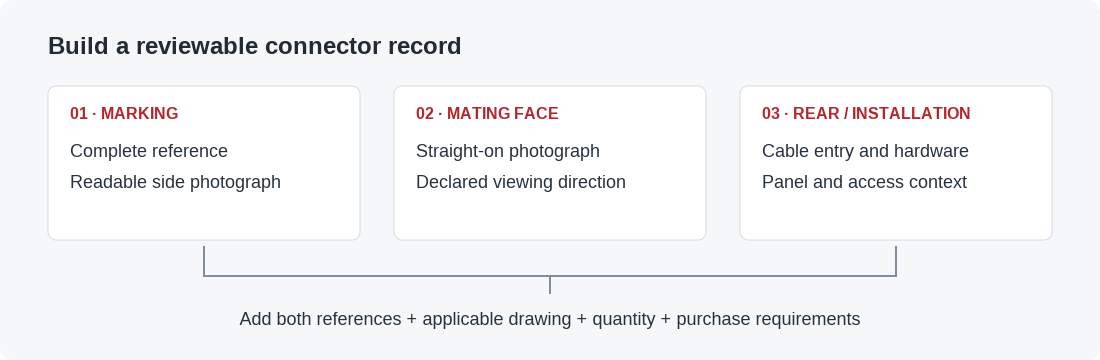
Figure 1. Original Tradin photo-submission map. This is an information checklist, not a connector drawing or a record of a completed fit test.

Figure 2. Amerline AEC 95234 family reference photograph showing a reverse-bayonet plug interface. Source: Amerline. Manufacturer reference only; this is not a Tradin sample, qualification claim or tested mating pair.
Shared insert ancestry does not establish a complete mating interface
Glenair describes its VG95234 product family as reverse-bayonet connectors with relationships to 5015-style insert arrangements. That relationship is useful background, but it does not make every 5015-style connector a VG95234 mating half. [1]
Keep the coupling identification separate from the contact layout. If a proposed reference belongs to a different coupling interface, a familiar-looking insert is not enough to continue with the same purchase assumption. Ask for the complete manufacturer reference and interface drawing.
The VG95234 sourcing page describes the family-level review inputs. It does not turn a partial marking into a complete, available SKU.
Collect evidence in an order that reduces rework
| Record | What to provide | What the reviewer can establish |
|---|---|---|
| Marking | Full text and a readable side photograph for each half | The actual reference requiring a drawing |
| Overall form | Side and rear views, with cable or panel context | Which body and rear configuration are involved |
| Mating face | Straight-on, labelled by connector and viewing direction | Visible interface features to compare with the drawing |
| Shell/insert and contacts | Complete designation and any cavity information | Whether the documented electrical configurations are candidates |
| Polarization | Full suffix and applicable keying information | Whether a missing or different position remains unresolved |
| Installation | Panel drawing, cable entry and nearby restrictions | Whether the proposal can also meet the mechanical installation |
If the marking is unreadable, preserve the uncertainty. A measurement may help narrow an identification, but it should not be converted into an invented full part number. Likewise, an overall photograph can support identification without proving sealing, environmental ratings or qualification.
Use three decision states
Documented candidate: the references and drawings support a specific pair for further project review. Record the drawings used and the remaining installation or purchase conditions.
Insufficient evidence: the marking, drawing, contact designation or polarization is incomplete. Request the missing input. Avoid quoting a substitute as if those fields had already been settled.
Documented mismatch: a required interface or configuration field is different. Record that difference explicitly so the next quotation does not repeat the same assumption.
This is a reusable review record, not a fabricated customer case. No mating test or customer installation is claimed for this article.
Include the rear assembly in the replacement request
A correctly identified front interface still leaves the rear package to be reviewed. State what must be included: cable-side hardware, sealing items, shielding requirements, protection or other specified accessories. Record the cable dimensions and available space.
Do not select those parts solely because a catalog family name is similar. Glenair's published ITS assembly information is an example of manufacturer-specific instructions with defined components and processes; use the instructions for the exact proposed item. [2]

Figure 3. André Kuipers documenting fluid and electrical interfaces in Quest, 27 January 2012. This supports the need for labelled interface views; it is not a VG95234 application claim. Credit: NASA/Andre Kuipers. Original archive. Context only; the connector series is not identified and this is not a Tradin installation or endorsement.
Request a review that can lead to an actual quotation
Send the two complete references or the known equipment connector plus its drawing. Add the three photograph types in Figure 1, quantity, required date and delivery destination. Identify any named-maker, original-only, qualification or documentation requirement before a supplier proposes an alternative.
The useful commercial output is a quotation identifying the actual proposed item, its included components and its unresolved conditions. A family-level statement of compatibility is not that output.
For wider background, read the existing VG95234 selection guide. This article addresses the narrower question of what to check when a proposed pair will not mate.
Send the references and interface photographs →
References
[1] Glenair VG95234 catalog, reverse-bayonet family and applicable body/interface information.
[2] Glenair ITS assembly instructions, manufacturer-specific component and assembly scope. These sources describe Glenair products; they do not qualify or endorse a Tradin offer. Checked 18 October 2026.
FAQ
Does a shared 5015-style insert prove complete mating?
No. The complete coupling interface and configuration must be checked. Shared insert ancestry is not proof of a complete mating pair.
What if the VG marking cannot be read?
Preserve the uncertainty. Supply clear photographs, the known mating reference and available drawings instead of inventing a full designation.
Which photographs should I provide?
Readable marking, straight-on mating face with a declared viewing direction, and rear/installation views showing hardware and access.