
Technical Articles
Injection-Molded Connector Boots vs. Molded Heat-Shrink Boots
2026-09-07T02:00:00.000Z
CONNECTOR BOOT DECISION GUIDE · DRAFT FOR PRE-REVIEW
CONNECTOR BOOT DECISION GUIDE · DRAFT FOR PRE-REVIEW
Injection overmolding and molded heat-shrink boots can both protect the connector-to-cable transition, but they create very different tooling, assembly, repair and validation paths. The best option depends on production volume, cable variation, sealing objectives, serviceability, material compatibility and the backshell or connector interface.
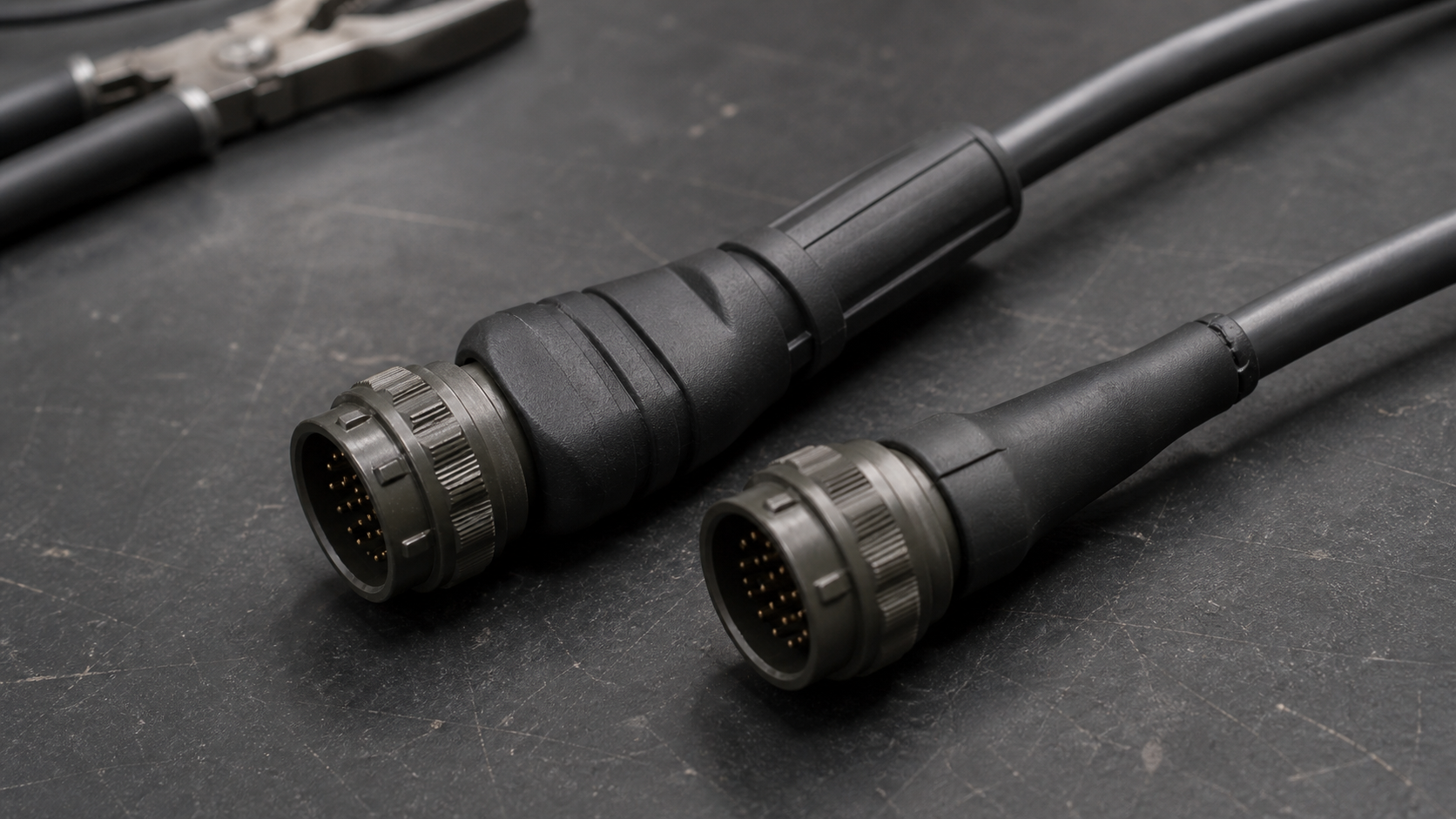
Representative harness-protection components. Final boot, material, adhesive and connector interface require drawing and process validation.
What is the difference?
An injection-molded or overmolded strain relief is formed directly around the connector/cable assembly in a dedicated mold. A molded heat-shrink boot is a preformed recoverable part that is positioned over the connector adapter and cable, then heated so it conforms to the assembly; a compatible adhesive may be used when sealing is required.
Both approaches can support strain relief and environmental protection, but neither performance level should be assumed from the process name alone. Connector design, cable jacket, material system, geometry, process control and validation determine the finished result.
Choose the process from the assembly, service and volume requirements - not from the appearance of the finished boot.
When injection overmolding is usually considered
The connector and cable configuration is stable enough to justify dedicated tooling.
Production volume can absorb mold design, sampling and qualification costs.
A repeatable integral strain-relief shape is needed around a defined cable jacket and connector geometry.
The assembly is not expected to be reopened at the connector rear during normal service.
The molding material and process temperature/pressure are compatible with the connector, cable, seals and terminations.
Molex describes overmolded cable assemblies as providing rugged strain relief at the connector-to-cable interface, while its mold-tool guidance notes that custom overmolding requires purpose-designed tooling and careful control of the connector, cable and strain-relief geometry.
When a molded heat-shrink boot is usually considered
Low-to-medium volumes, prototypes, repair programs or mixed connector/cable combinations favor range-taking parts.
The selected backshell or adapter provides a compatible boot lip, groove or knurled landing area.
The assembly process can control surface preparation, adhesive placement, recovery temperature and inspection.
A spin-coupling or other serviceable adapter is selected when future rear access is required.
The boot material and adhesive system are documented for the cable jacket, environment and operating temperature.
TE describes Raychem molded heat-shrink boots as preformed parts that recover over the connector transition and can form a watertight seal when the specified sealant or adhesive system is used. TE also distinguishes fixed adapters from spin-coupling adapters: serviceability depends on the complete adapter and boot design, not just the boot.
Decision factors procurement and engineering should compare
Tooling and commercial model
Injection overmolding normally requires design and manufacture of dedicated tooling, then sample approval and process qualification. It can become economical at stable production volumes. Heat-shrink boots use catalog or custom molded shapes with installation tooling and consumables, making them easier to deploy across smaller or mixed batches.
Configuration flexibility
A heat-shrink family can often cover a defined range of cable diameters and connector adapter sizes. Overmolding is more tightly linked to the mold cavity, connector loading fixture and cable geometry; design changes may require tooling changes or new validation.
Service and repair
A permanent overmold can make rear access difficult or destructive. Heat-shrink systems may support repair when paired with a suitable spin-coupling adapter and an approved rollback or replacement process. A fixed adapter and bonded boot can still be non-serviceable, so the complete architecture matters.
Sealing
Neither process should be labeled waterproof without system-level evidence. For overmolding, the bond to the connector and cable jacket, material compatibility, void control and cable construction are critical. For heat-shrink boots, recovered dimensions, lip engagement, adhesive selection, surface preparation, heating and inspection determine the sealed transition.
Strain relief and bend control
Overmolding can integrate a defined straight or segmented bend relief. Heat-shrink boots are available in straight and angled shapes and can bridge from a backshell or boot adapter to a cable. In both cases the design should keep mechanical loads away from contacts and rear seals and respect the cable bend radius.
Shielding and EMI termination
A boot is not the shield termination by itself. If the cable shield must bond to the connector shell, select and validate the applicable backshell, band, cone, ring or other termination method first. The overmold or heat-shrink boot then protects and supports that controlled interface where specified.
A practical selection workflow
Define connector, cable, backshell or adapter and the complete rear-interface drawing.
Define the required functions separately: strain relief, bend control, sealing, abrasion protection, shielding support and service access.
Record cable outside-diameter range, jacket material, temperature, fluids, vibration and installation-space limits.
Estimate program volume, configuration stability, tooling budget and acceptable lead time.
Choose candidate material and adhesive systems using manufacturer data rather than generic polymer names.
Build representative samples using the intended production process and operators.
Validate dimensional fit, pull/strain performance, sealing and environmental requirements appropriate to the application.
Freeze the drawing, bill of materials, process parameters and inspection criteria before production release.
Common mistakes
Comparing only piece price while ignoring overmold tooling, sampling and change costs.
Selecting a heat-shrink boot by unrecovered appearance instead of recovered dimensions and cable range.
Assuming adhesive automatically bonds to every cable jacket or connector finish.
Using a boot to compensate for a mismatched backshell, unsupported cable or incorrect bend radius.
Calling an assembly sealed without a documented process and validation result.
Treating an AI or catalog image as proof of the delivered material, installation or performance.
Frequently asked questions
Which option is better for low-volume connector projects?
Molded heat-shrink boots are often easier to evaluate for low volumes because they avoid dedicated overmold tooling, but the correct choice still depends on the connector adapter, cable range, environment, process capability and repair strategy.
Is an injection-molded boot always more durable?
No. Durability depends on material, geometry, cable compatibility, molding quality, strain distribution and validation. A poorly designed overmold can fail, while a correctly selected and installed heat-shrink system can perform well within its documented application.
Can a heat-shrink boot provide strain relief and sealing?
It can contribute both when it is matched to the connector adapter and cable, installed with the specified adhesive or sealant, and validated as a system. Do not infer a sealing rating from the boot alone.
What should be sent for a quotation?
Send the connector and backshell or adapter part numbers, drawings, cable construction and outside diameter, exit angle, material/environment requirements, volume, serviceability target and planned validation. Photos help communicate the geometry but do not replace drawings.
Related Tradin Connect resources
Harness protection category: https://tradintech.com/harness-protection
Connector accessories: https://tradintech.com/connector-accessories
Heat-shrink boot for connectors: https://tradintech.com/products/heat-shrink-boot-for-connector
S1125-equivalent adhesive: https://tradintech.com/products/s1125-equivalent-adhesive
Request a quote: https://tradintech.com/request-a-quote
Sources used for this draft
Use the current product drawing, applicable specification and approved internal engineering documents for final design decisions. These public sources support the editorial draft:
TE Connectivity - Heat shrink boots: https://www.te.com/en/products/wire-protection-and-management/heat-shrink-shapes/heat-shrink-boots.html
Molex - Custom overmolded cable assemblies: https://www.molex.com/en-us/products/cable-assemblies/custom-cable-assembly-solutions
Molex - Mold tool design for insert molding: https://www.molex.com/en-us/blog/mold-tool-design-for-insert-molding
Request a connector-boot design review
Send the complete connector or backshell part number, drawing, photo, cable details, quantity and BOM to Tradin Connect for matching and quotation. State whether you require an original item, a compatible option for validation, or a drawing-based custom solution.