
Technical Articles
Receiving Inspection for Circular Connectors: Markings, Parts and Documents
2026-11-04T09:07:00.000Z
Check connector identity, quantities, included parts and order-specific documents. Separate visual observations, traceability and qualification evidence.
Receiving a circular connector is a comparison against the purchase requirement, not a chance to infer approval from its appearance. Start with the ordered reference and delivery scope, then reconcile the item, packaging, quantities, accessories and required documents.
A visual check can identify discrepancies for review. It cannot by itself prove authenticity, qualification or the full performance of a connector.

Figure 1. Original supplier photograph of an individually protected receptacle and a separate mounting seal. Packaging and included hardware are receiving inputs; this photograph does not prove document traceability or a passed inspection.
Prepare the acceptance record before delivery
The receiving team needs the same requirement that the buyer placed. Give it the complete part number, proposed maker/item if separately identified, quantity, included-parts list, approved changes and required document list.
If an alternative was accepted, retain the actual acceptance record with the order. A receiver should not have to reconstruct that decision from an email saying “equivalent is OK.” Equally, an original-only requirement should remain explicit in the purchase and receiving records.
| Check | Compare against | Record when something differs |
|---|---|---|
| Item identity and marking | Ordered reference and accepted proposal | The exact conflicting or unreadable field |
| Quantity and packaging | Order, packing list and actual contents | Count, package identity and condition |
| Included components | Agreed list of contacts, accessories and other items | Missing, extra or unidentified components |
| Visible condition | Applicable inspection requirements | Observation and photographs for disposition |
| Documents | Order-specific document requirements | Missing document or unresolved scope |
| Mating/installation evidence | Approved drawing and project procedure | Any review still required before use |
The table is an original purchasing checklist. It does not prescribe test limits or replace an organization's receiving procedure.
Keep three kinds of evidence separate
Conformity statement. Read the statement itself: who issued it, which item and quantity it addresses, and what conformity is being stated. A document title alone does not establish every requirement of an aerospace purchase.
Traceability information. Check whether the supplied records satisfy the chain and detail required by the order. Preserve the association between the records and the actual delivery. A label photograph is useful evidence, but it is not automatically a complete traceability package.
Qualification information. DLA identifies the Qualified Products Database as the official repository for applicable qualification information. Where the purchase requires qualification, the responsible reviewer should verify the applicable listing and its scope. A familiar military reference or a supplier's general certificate is not a substitute for that check. [1]
Do not create sample certificates to fill a content page or use another manufacturer's qualification as proof of the offered item. This article contains no certificate specimen or implied Tradin qualification claim.
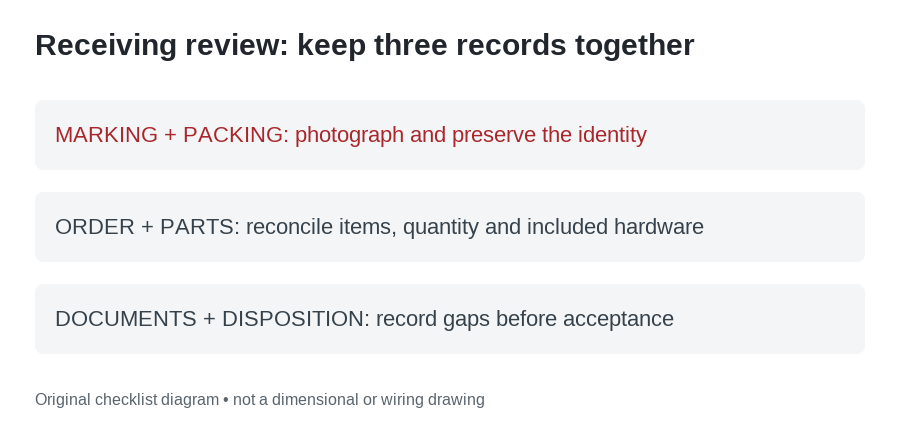
Figure 2. Original receiving-review checklist: identify the delivered item, reconcile it to the order and record any document or included-parts gap. This is not a completed inspection record.
Hold an unresolved item for a documented decision
Record the discrepancy in plain terms: “one character in the marking is unreadable,” “the agreed rear clamp is missing,” or “the required document has not been supplied.” Identify the affected order line and quantity, and follow the organization's disposition process before the item is put into service.
Do not silently correct an unexplained marking in the stock record, combine unrelated document sets or use a connector's colour as the acceptance criterion. Keep the observation and the decision separate so the next person can follow the record.
Where mating or electrical inspection is required, use the applicable approved procedure. NASA's published connector-handling standard illustrates the importance of defined instructions and their scope; it is not a generic incoming-inspection approval or a claim about a Tradin delivery. [2]
Put the document requirements in the RFQ
Resolving document scope before order placement reduces avoidable disputes at receipt. List the required records, any named-maker or original-only condition, quantity, destination and required arrival date.
For delivery-sensitive projects, keep dispatch, transport planning and arrival requirements separate. IATA's 7 June 2026 outlook described Middle East disruption and effects on cargo networks. That dated context supports checking current transport assumptions with the supplier and carrier; it does not establish today's stock or a guaranteed route for any connector. [3]

Figure 3. Aerospace technician Kevin Wyckoff examining an electrical wiring harness in a Kennedy laboratory, 4 January 2008. Visual-inspection context only: this is not a Tradin receiving record. Credit: NASA/KSC. Original archive. Context only; the connector series is not identified and this is not a Tradin installation or endorsement.
For a sourcing review, identify the relevant MIL-SPEC connector family and send the complete references, quantity and document requirements. State what your receiving team must be able to accept.
Request a quotation with the required delivery documents →
References
[1] DLA: QPD/QPL — Qualified Products Database, role of the official qualification repository.
[2] NASA GSFC connector mating and demating standard, defined handling scope and precedence of approved instructions.
[3] IATA industry outlook, 7 June 2026, dated logistics background only. Sources checked 18 October 2026.
FAQ
Can visual inspection prove authenticity or qualification?
No. It can identify discrepancies for review, but it cannot by itself establish authenticity, qualification or all performance requirements.
Does a document called a CoC prove every purchase requirement?
Read the actual statement, issuer and scope, then compare it with the order. Its title alone does not establish every required condition.
When should document requirements be discussed?
Include them in the RFQ and purchase requirement before ordering, alongside original-only or alternative-evaluation conditions and delivery needs.